


What is HSG (Hysterosalpingography)?
Hysterosalpingography, commonly referred to as HSG, is a procedure used to visualize the uterus and fallopian tubes.
In families who want to have children but are unable to do so (infertility), approximately 1/3 of the women, 1/3 of the men, and 1/3 of both women and men may have a disease.
When investigating whether the woman has a disease, it is necessary to visualize the uterus and fallopian tubes. This film allows for the diagnosis of congenital malformations (birth defects) of the uterus, adhesions that have formed later, and diseases of the fallopian tubes such as adhesions, narrowing, blockages, and dilation.
What is HSG (Hysterosalpingography)?
Hysterosalpingography, commonly referred to as HSG, is a procedure used to visualize the uterus and fallopian tubes.
In families who want to have children but are unable to do so (infertility), approximately 1/3 of the women, 1/3 of the men, and 1/3 of both women and men may have a disease.
When investigating whether the woman has a disease, it is necessary to visualize the uterus and fallopian tubes. This film allows for the diagnosis of congenital malformations (birth defects) of the uterus, adhesions that have formed later, and diseases of the fallopian tubes such as adhesions, narrowing, blockages, and dilation.
How is it done?
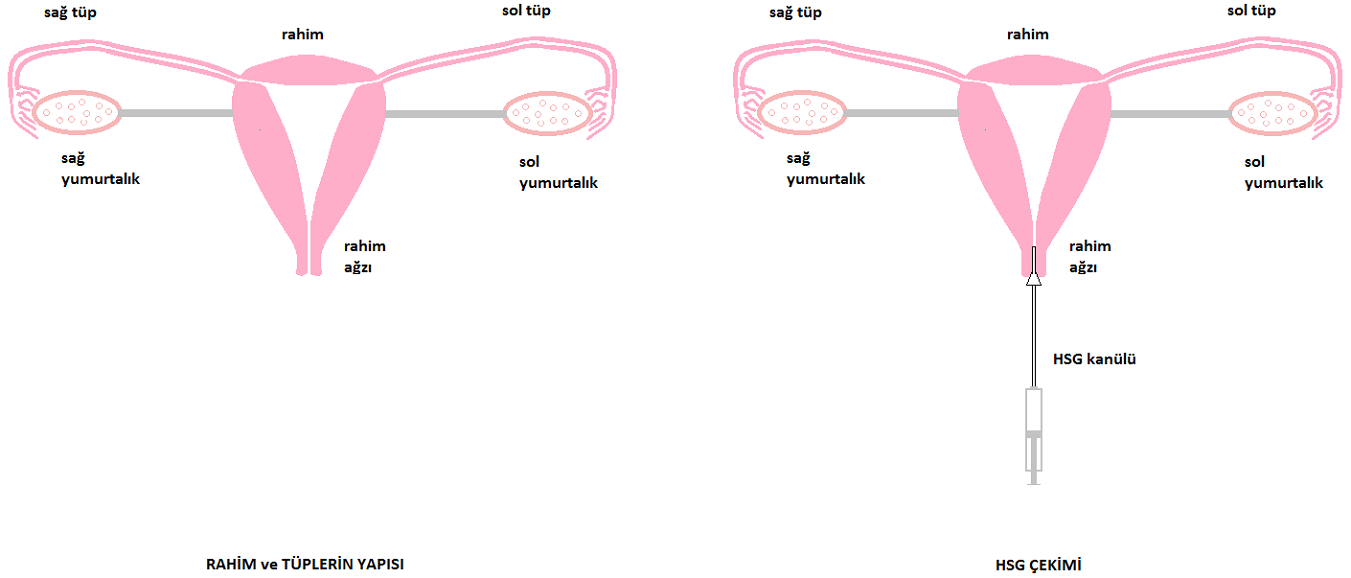
With the method we have developed, HSG is performed in our clinic in most cases without pain and in some cases with very little discomfort (as much discomfort as menstrual cramps). A device is placed in the cervix to administer a colored dye, and the imaging is performed visually.
Our trained and experienced female technician will take you to the procedure room. Preparations are made together with the Specialist Doctor, and then the procedure begins. The procedure itself takes approximately 30 seconds. However, including the preparations before the procedure, you will be in the procedure room for about 10 minutes.
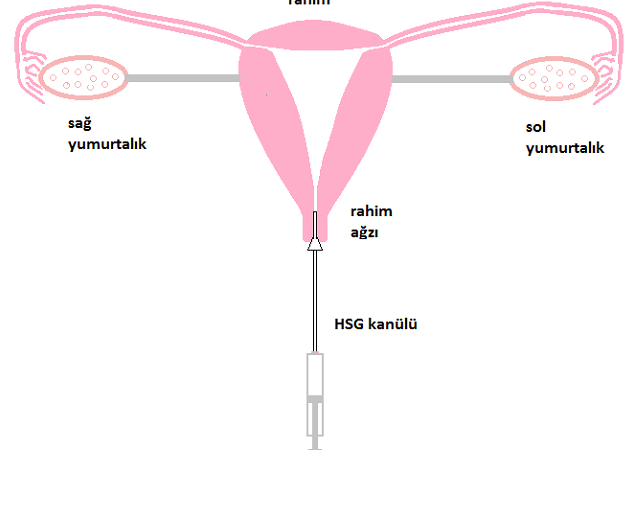
The figure shows the normal anatomical structure of the uterus and fallopian tubes.
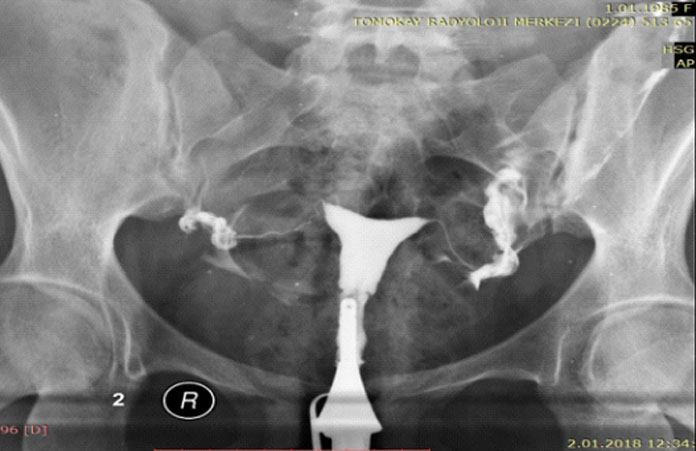
HSG imaging definitively diagnoses whether there is disease in the uterus and fallopian tubes.
The film shows a congenital anomaly in the uterus and slight dilation of the tubes. The case will be treated with this diagnosis.
How should I prepare?
The HSG film is taken after your period ends. It is suitable between the 1st and 5th day after your period ends. If we count the day you wash after your period as day 1, we prefer the 2nd, 3rd, 4th, and 5th days at our clinic.
You do not need to be fasting. The examination is performed a few hours after eating.
We recommend that you arrive at our clinic 15 minutes before your appointment time.
Before the procedure, you will be asked to use the restroom to urinate and, if possible, have a bowel movement.
When will I receive my results?
After the procedure, you will rest at our clinic for 15 minutes. During this time, your report and film will be prepared and given to you.